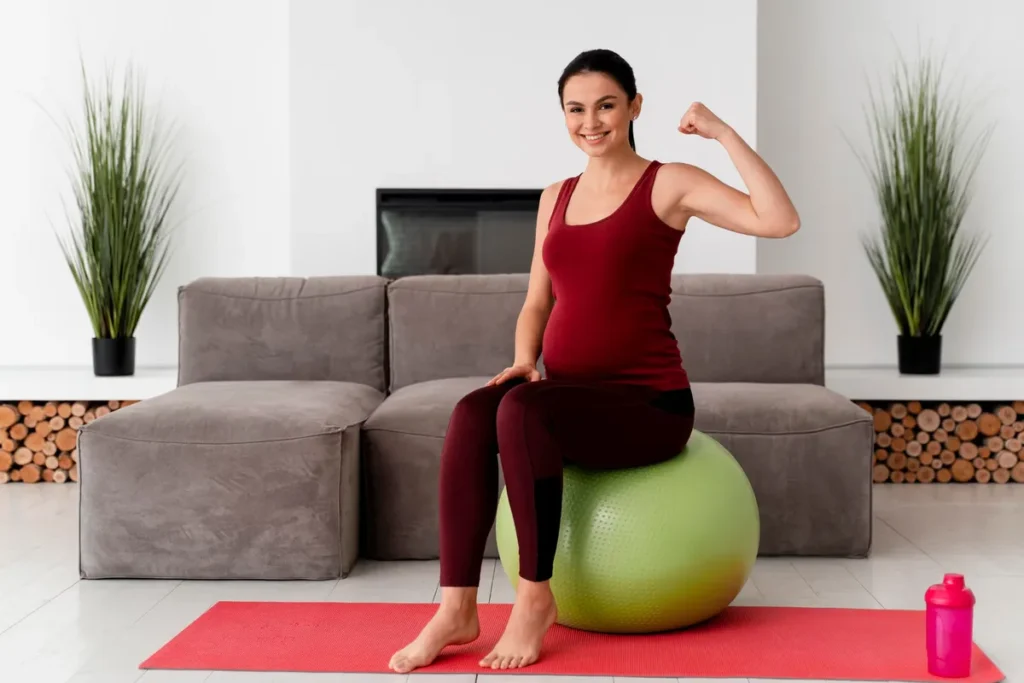
There is a good chance a big, round exercise ball is already sitting somewhere in your home. During pregnancy, it may become the most comfortable seat you own. Fitness ball exercises for pregnancy are gentle, low-impact and easy to do at home, and the same ball doubles as a cosy chair when the sofa stops feeling good. Many moms-to-be love them because the ball supports your body as it changes, instead of working against it.
In this guide you will find 10 safe moves sorted by trimester, the safety checks to run before you begin, the movements to skip, and how to pick the right ball. One gentle reminder before anything else: check with your doctor or midwife first, especially if your pregnancy is considered high risk.
Benefits of Using a Fitness Ball During Pregnancy
A fitness ball, sometimes called a birth ball or balance ball, is one of the simplest pieces of pregnancy gear you can own. Here is why so many expecting moms keep one close by. If you are new to prenatal movement, our guide to [Internal link: safe pregnancy exercises by trimester -> insert URL] is a helpful place to start.
- Eases pressure on the lower back. Sitting on a ball gently nudges you into an upright, relaxed posture, which may help reduce the aching that comes with a growing bump.
- Wakes up your deep core and pelvic muscles. You stay slightly active just to stay balanced, so your core works softly without any crunches or strain. Pair this with [Internal link: pelvic floor exercises during pregnancy -> insert URL] for extra support.
- Keeps your hips open and mobile. Rocking, swaying and gentle squats can support hip flexibility as your body prepares for birth.
- Builds balance and body awareness. Your centre of gravity shifts week by week. Regular balance ball pregnancy practice can help you feel steadier on your feet.
- Makes daily movement easy. On tired days, even five minutes of seated sways counts. The ball is right there, no gym required.
Safety Tips Before You Start
A fitness ball is very safe when you use it well. A few simple habits make every session feel calm and supported.
- Get the green light first. Check with your doctor or midwife before starting any new routine, especially if you have a high-risk pregnancy, bleeding, high blood pressure or a low-lying placenta.
- Check the size and inflation. When you sit on the ball, your knees should be level with or slightly below your hips. The ball should feel firm with a little give, not rock hard and not squishy.
- Use a non-slip surface. Place the ball on a yoga mat, carpet or an anti-slip ball base. Avoid tiles or polished wooden floors, and never exercise in socks on a smooth floor.
- Keep support within reach. Position yourself near a wall, a sturdy chair or your partner so you always have something to hold if you wobble.
- Dress and breathe well. Wear supportive shoes or go barefoot, keep a bottle of water nearby, and never hold your breath during a move.
- Know when to stop. Stop right away if you feel dizzy, short of breath, pelvic pain, cramping, bleeding or any leaking fluid. Rest, and call your provider.
10 Safe Fitness Ball Exercises for Pregnancy (Sorted by Trimester)
Start with the moves listed for your current trimester. Most of the “all trimester” moves will stay with you right up to your due date, so you can build a small routine and keep adjusting it as the weeks go by.
First Trimester Moves (Weeks 1 to 12): Gentle Foundations
1. Seated Pelvic Tilts
This is the move almost every prenatal class begins with, and for good reason. It teaches your pelvis to move freely and may help release a tight lower back from day one.
Trimester: All trimesters, and a perfect starting point in the first.
Target/benefit: Pelvic mobility, lower back release and gentle core awareness.
How to do it:
- Sit tall on the centre of the ball with your feet flat on the floor, hip-width apart.
- Breathe in and tip your pelvis forward so your lower back forms a small arch.
- Breathe out and tuck your tailbone under, rounding your lower back softly.
- Keep your shoulders quiet and let only your hips do the moving.
Reps/duration: 8 to 10 slow tilts, 2 rounds.
Safety tip: Keep the movement small and smooth. This is a gentle rock, not a bounce, so there is no need to rush through it.
2. Wall Squat with the Ball
Squats build the leg and glute strength you will lean on during late pregnancy and birth. Adding the ball against a wall makes this a steadier ball exercise for pregnant women than a free-standing squat.
Trimester: First and second. In the third, only with your doctor’s approval and a shallow range.
Target/benefit: Legs, glutes and upright posture.
How to do it:
- Stand with the ball pressed between your lower back and a wall.
- Walk your feet forward a little, slightly wider than hip-width.
- Bend your knees and slide down until your thighs are about halfway to parallel.
- Press through your heels and roll back up to standing.
Reps/duration: 6 to 8 squats, 1 to 2 sets.
Safety tip: Keep your knees behind your toes. Skip this move entirely if you feel any pubic-bone or pelvic pain while lowering.
3. Knee Drops with Ball Support
Early pregnancy often brings a stiff, achy lower back before your bump even shows. This slow stretch may help loosen the sides of your waist and hips while you lie down and breathe.
Trimester: First trimester only. Lying flat on your back is best avoided after about 20 weeks.
Target/benefit: Side-waist stretch, lower back and hip release.
How to do it:
- Lie on your back with your knees bent and feet flat. Hold the ball lightly between your knees.
- Keep your shoulders relaxed on the floor and let both knees fall gently to the right.
- Bring your knees back to centre with control.
- Let them drop to the left, breathing out as they lower.
Reps/duration: 5 to 6 drops to each side.
Safety tip: Stop if you feel light-headed at any point, and retire this move as soon as your provider advises against lying on your back.
Second Trimester Moves (Weeks 13 to 26): Building Strength and Mobility
4. Kneeling Chest-on-Ball Circles
As your bump grows, your spine takes on new work and mid-pregnancy backache is very common. This soothing exercise ball pregnancy workout lets your belly hang free while your back gets a gentle, moving stretch. For more relief ideas, read our tips on [Internal link: relieving back pain during pregnancy -> insert URL].
Trimester: Second and third.
Target/benefit: Back pain relief, spinal mobility and light core engagement.
How to do it:
- Kneel on a mat with the ball directly in front of you.
- Rest your upper chest and forearms on the ball so your belly hangs comfortably.
- Use your hips to roll the ball in small clockwise circles.
- After a few circles, switch to anticlockwise.
Reps/duration: 20 to 30 seconds in each direction.
Safety tip: Set up with the ball close to a wall so it cannot roll out from under you.
5. Kneeling Leg Extension with Ball
This move quietly trains your balance and glutes at the same time. It is one of the most useful balance ball pregnancy exercises because it mirrors everyday actions like stepping and reaching.
Trimester: Second. First trimester too, if it feels comfortable.
Target/benefit: Core stability, glute strength and balance.
How to do it:
- Start on all fours with the ball resting behind one foot.
- Slowly press the ball back as you straighten that leg behind you.
- Hold for 2 to 3 breaths, keeping both hips level with the floor.
- Draw the leg back in with control and repeat on the other side.
Reps/duration: 5 extensions on each leg.
Safety tip: Do not let your lower back dip or sag. Shorten the range of movement if your belly starts pulling you forward.
6. Low Lunge Hip Opener with Ball
Tight hip flexors can tug on your lower back and make sitting uncomfortable. This supported lunge may help open the front of your hips while the ball keeps you steady.
Trimester: Second and third.
Target/benefit: Hip flexor stretch, pelvic flexibility and gentle preparation for birth.
How to do it:
- Step one foot forward into a kneeling lunge, with your back knee on a cushion.
- Rest both hands on top of the ball in front of you for balance.
- Breathe out and let your hips sink forward slowly, without forcing it.
- Hold, breathe, then switch legs.
Reps/duration: 20 to 30 seconds on each side, 2 rounds.
Safety tip: Keep your front knee stacked over your ankle. Set up beside a wall if your balance feels wobbly.
7. Wide-Stance Ball Squat
A wide squat works the inner thighs and hips, which do a lot of heavy lifting as your pregnancy progresses. Holding the ball in front of you adds a little counterbalance and keeps your chest lifted.
Trimester: Second. Third as well, as long as you have no pelvic girdle pain.
Target/benefit: Inner thighs, hips and lower-body endurance.
How to do it:
- Stand with your feet wider than your shoulders and toes turned slightly out.
- Hold the ball at chest height with both hands.
- Sit your hips back and down only as far as feels easy.
- Rise slowly, pressing through your whole foot.
Reps/duration: 6 to 8 squats.
Safety tip: Skip this move if you feel any sharp pain across the front of your pelvis. That is a sign to rest and speak to your provider.
Third Trimester Moves (Weeks 27 to 40): Comfort and Labour Prep
8. Seated Spinal Twist on the Ball
By the third trimester your ribs and upper back may feel squeezed as your baby takes up more room. A gentle seated twist may help create a little space and ease that tight, breathless feeling.
Trimester: Third, and safe in all trimesters.
Target/benefit: Upper back and rib-cage relief, spinal mobility.
How to do it:
- Sit tall on the ball with your feet wide for a stable base.
- Breathe in and reach both arms up toward the ceiling.
- Breathe out and turn gently from your upper body to one side, resting one hand on your thigh.
- Return to centre and repeat on the other side.
Reps/duration: 5 twists to each side.
Safety tip: Twist from your ribs, not your belly. Keep the turn open and shallow, and never pull yourself deeper.
9. Seated Side-to-Side Hip Sways
This is the move many moms end up doing without thinking, because it just feels good. Gentle swaying may support circulation in your legs and ease pressure on your tailbone.
Trimester: Third, and useful in all trimesters.
Target/benefit: Leg circulation, swelling relief, sacrum and tailbone comfort.
How to do it:
- Sit in the centre of the ball with your hands resting on your knees.
- Shift your weight onto your right hip, then glide across to your left.
- Let the ball roll a little underneath you with each sway.
- When it feels natural, try tracing slow figure-8 shapes with your hips.
Reps/duration: 1 to 2 minutes, several times a day.
Safety tip: Keep both feet flat on the floor the whole time. This is a sway, not a lean.
10. Gentle Seated Bouncing (Full Term Only)
In the final weeks, pelvic pressure can make sitting on hard chairs uncomfortable. Soft, rhythmic bouncing is a comfort tool many moms reach for once they are full term. If you are counting down the days, our [Internal link: preparing your body for labour -> insert URL] guide walks you through more ways to get ready.
Trimester: Third, from 37 weeks and only with your provider’s OK.
Target/benefit: Pelvic pressure relief and comfort in late pregnancy.
How to do it:
- Sit on the ball right next to a wall or sturdy chair.
- Press lightly through your feet to create a tiny, soft bounce.
- Keep the rhythm slow and low, almost like a gentle rock.
- Pause and take a few calm breaths after each short round.
Reps/duration: 30 to 60 seconds, rest, then repeat 2 to 3 times.
Safety tip: No big bounces. Stop at once if you feel unusual pressure, pain or any leaking fluid, and contact your provider.
Exercises and Movements to Avoid on a Fitness Ball During Pregnancy
The ball is a wonderful tool, but not every move you see online is pregnancy-friendly. Here are the ones to leave out.
- Lying flat on your back over the ball after around 20 weeks. This position may reduce blood flow for some moms, so swap it for seated or kneeling moves.
- Crunches, sit-ups or anything that folds you over your belly. These put pressure on your abdominal wall at a time when it is already stretching.
- Planks or push-ups with your hands or feet on the ball. The wobble makes a fall more likely, and the strain on your core is too much right now.
- Kneeling or standing on top of the ball. This is risky even for athletes who are not pregnant.
- Fast, high bouncing at any stage. Save gentle bouncing for full term, and keep it low even then.
- Deep twists through the belly or holding your breath to push through a move. Keep everything soft, open and well-ventilated.
- Any ball exercise if you have certain conditions. If you have been told you have placenta previa, cervical weakness, a risk of preterm labour or uncontrolled blood pressure, ask your provider before using the ball at all.
How to Choose the Right Exercise Ball for Pregnancy
The right ball makes every one of these fitness ball exercises for pregnancy feel safer and more comfortable. Here is what to look for.
- Size by height. Under 5’3″ (160 cm), choose a 55 cm ball. Between 5’3″ and 5’8″ (160 to 173 cm), choose 65 cm. Over 5’8″, choose 75 cm. When seated, your knees should sit level with or slightly lower than your hips.
- Anti-burst rating. Look for “anti-burst” or “burst-resistant” on the label, along with a weight limit of at least 300 lb (135 kg). If punctured, this type of ball deflates slowly instead of popping.
- Material. Choose a thick, BPA-free and phthalate-free PVC with a slightly textured, non-slip finish. Smooth, shiny balls can slide on hard floors.
- Helpful extras. A foot pump saves your energy, a stability ring or base stops the ball rolling away, and a wipe-clean surface keeps things hygienic.
- Think long term. A quality birth ball also comes in handy during labour and in the postpartum months for feeding and rocking, so it is worth choosing well.
Final Thoughts on Fitness Ball Exercises for Pregnancy
Fitness ball exercises for pregnancy are simple, soothing and easy to adapt from your first week to your due date. A few slow tilts, sways and supported squats can support your back, hips and balance without ever leaving your living room. Every pregnancy is different, though, so check with your doctor or midwife before you begin and whenever something feels off. Pick two or three moves from your trimester to try this week, and explore more pregnancy wellness guides on The Blessed Mom to keep feeling supported every step of the way.
Frequently Asked Questions
Can I start fitness ball exercises for pregnancy if I never exercised before?
Yes, in most cases you can start fitness ball exercises for pregnancy as a beginner, as long as your doctor or midwife gives you the go-ahead. Begin with the gentlest seated moves, such as pelvic tilts and hip sways, for a few minutes a day. Build up slowly and stop whenever something feels uncomfortable.
Is sitting on a balance ball during pregnancy good for you?
Sitting on a balance ball during pregnancy may support better posture, ease lower back pressure and keep your hips gently active. Many moms find it more comfortable than a sofa in later pregnancy. Start with 10 to 15 minutes at a time, keep both feet flat, and take breaks if you feel tired or wobbly.
Which trimester is best to start using an exercise ball?
You can start using an exercise ball in any trimester. In the first, focus on gentle seated moves and light squats. In the second, add kneeling and balance work. In the third, keep to seated sways, twists and comfort moves. Always adjust the range and pace to how your body feels that week.
Can bouncing on a ball induce labour?
No, there is no reliable evidence that bouncing on a ball induces labour. Gentle, low bouncing after 37 weeks is best seen as a comfort tool that may ease pelvic pressure and help you relax. Labour starts when your body and baby are ready, so use the ball for comfort, not as a way to speed things up.
How often should I do an exercise ball pregnancy workout?
Most moms do well with a short exercise ball pregnancy workout 3 to 5 times a week, around 10 to 20 minutes each. Gentle seated moves like sways and pelvic tilts can be done daily. Listen to your body, rest on tired days, and follow any limits your doctor or midwife suggests.
This article is for general information only and is not a substitute for professional medical advice.